

Related Post


Say Goodbye to Slow Gels with Fast Running Buffer
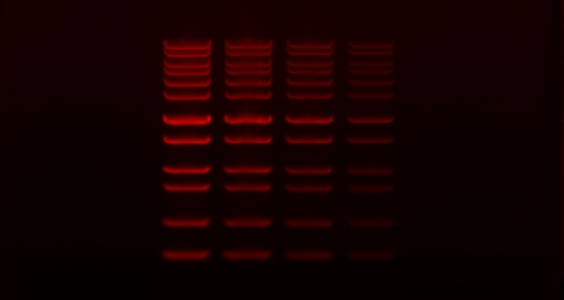
2025-12-15The Fast Running Buffer is a low-ionic-strength electrophoresis buffer engineered for quick, reliable agarose gels.It cuts typical 30-minute runs down to just a few minutes while keeping bands sharp and easy to interpret. Today, it is widely used in high-throughput cloning, next-generation sequencing workflows, CRISPR and other gene editing projects, as well as transcriptomics and gene regulation studies. Many research teams rely on it when they need rapid checks between key experimental steps, without sacrificing DNA recovery or downstream performance. But faster gels are only part of the story. How exactly does this buffer achieve speed without chaos, and what does it mean for your daily experiments? That is what we are going to explore next.
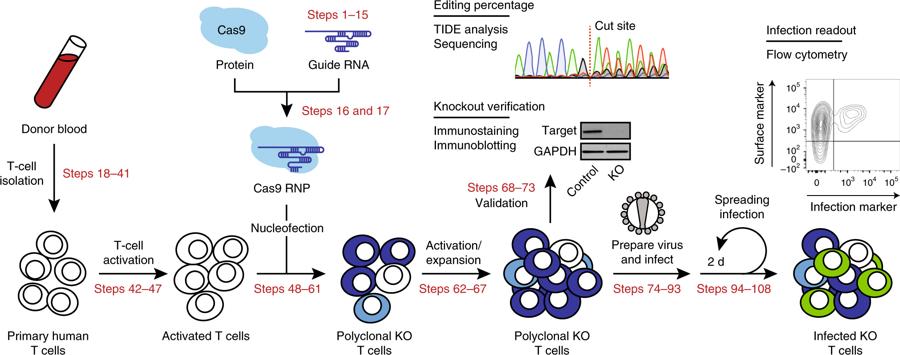
(CRISPR/Cas9 Gene Editing | Krogan Lab)
Why Slow Gels are Holding Your Lab Back
If you run gels every day, you know how often this happens: you prepare your agarose, load the samples, start the run… and then stare at a slowly advancing dye front. A “quick” 30-minute check run sounds harmless on paper, but in a real lab schedule it adds up fast.
Every slow gel means:
•The electrophoresis tank is occupied longer than it should be.
•You wait to confirm PCRs, digests, or cloning steps before moving on.
•Downstream tasks like ligation, transformation, or sequencing get pushed back.
Over a week of cloning, CRISPR editing, transcriptomics, or screening work, those half-hour runs quietly eat big chunks of your time. Throughput drops, timelines slip, and “I’m still waiting on the gel” becomes a familiar excuse.
Pushing standard TAE or TBE gels harder is rarely the answer. Turning up the voltage often brings problems: overheating, distorted bands, and inconsistent migration. After a few bad experiences, most teams go back to conservative conditions – accepting slow gels as a “necessary” bottleneck.
Fast Running Buffer is designed for exactly this pain point. It’s a low-ionic-strength buffer that lets you shrink typical ~30-minute separations down to about 5 – 10 minutes while maintaining sharp bands and reliable DNA recovery. Instead of planning your day around gel runs, you can treat them as quick checkpoints that keep your projects moving.
What Makes Fast Running Buffer Different
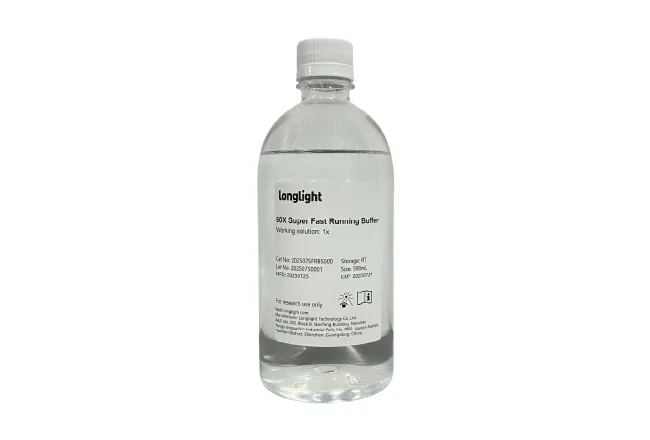
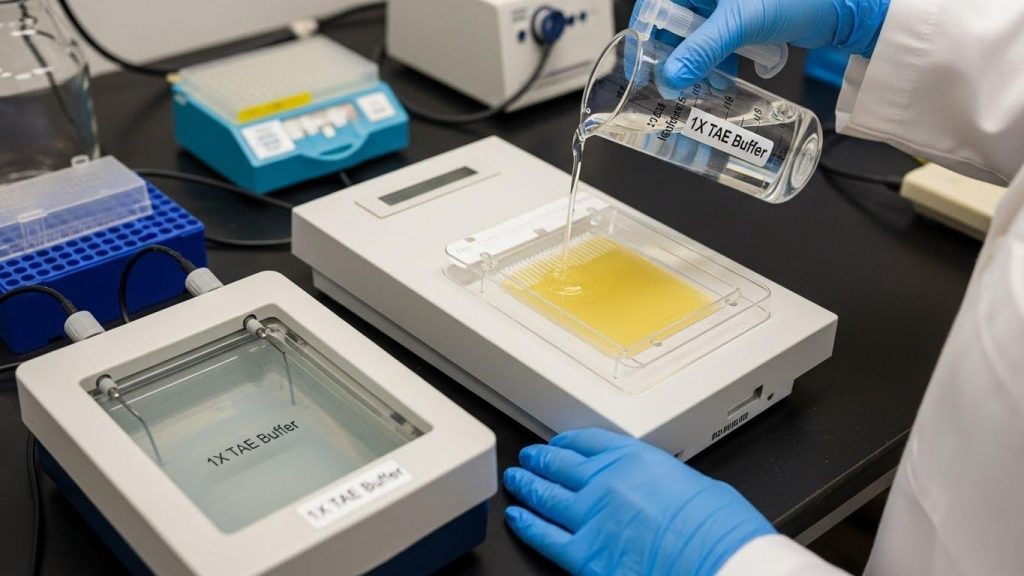
At its core, Fast Running Buffer is about speed without chaos. It is supplied as a 50X concentrate, so you simply dilute it to a 1X working solution with distilled water. That single 1X buffer can be used both for casting gels and for running electrophoresis, keeping conditions consistent from start to finish.
Compared with conventional 1X TAE or TBE systems, the buffer offers several practical advantages:
✅Significantly shorter run times – typical separations finish in about 5 – 10 minutes instead of ~30 minutes.
✅2.5 – 3× faster running – thanks to low ionic strength, you can run at around 25 – 30 V/cm without excessive heating.
✅Robust buffering capacity – the 1X solution can often be reused in routine workflows, helping reduce waste and cost.
Because the buffer carries less ionic strength, it generates less heat even at higher voltage. That means you can safely increase the field strength and still maintain intact, straight bands instead of “smiles” or blurry smears. The result is fast electrophoresis that still looks like the gels you trust for decision-making.
Equally important, Fast Running Buffer plays nicely with downstream applications. Fast Running Buffer is fully compatible with common DNA gel extraction and ligation kits. You can slice out the band you need, purify it as usual, and move right on to cloning or other downstream steps. No new workflow, no extra validation.
- Simple Workflow, Minimal Changes
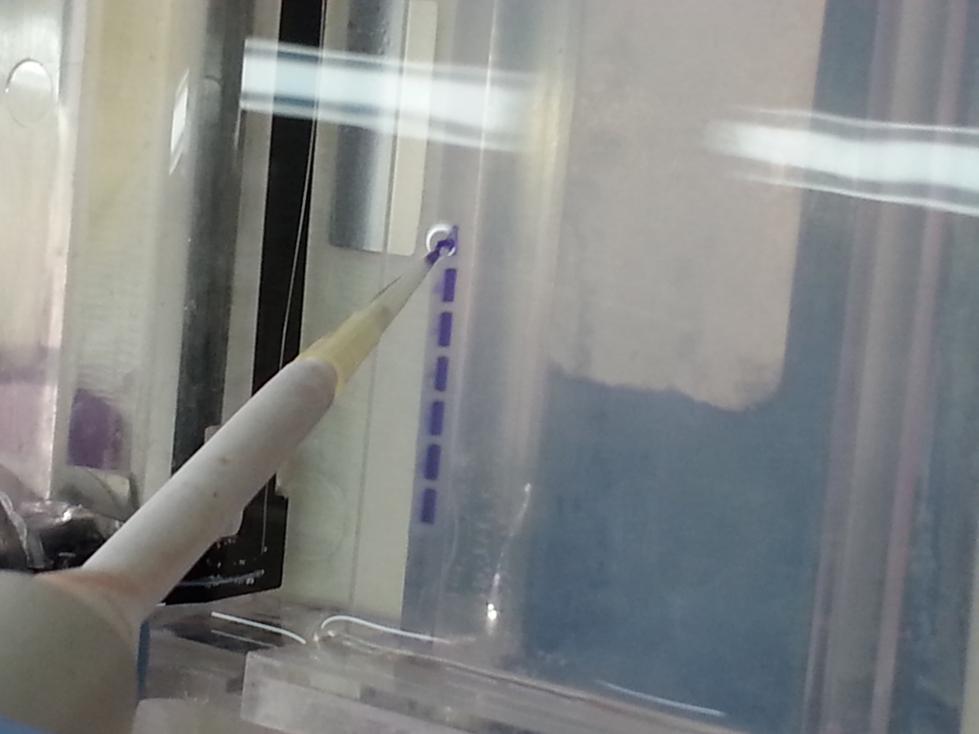
You do not have to rewrite your SOPs to use this buffer. Everyday handling is straightforward:
✅Prepare a 1X working solution by diluting the 50X concentrate with distilled water. Keep it at room temperature; it stays stable for months.
✅Use that same 1X batch to make the agarose gel and as the running buffer in the tank. This keeps the ionic strength uniform throughout the system and helps avoid strange migration patterns.
✅Do not dilute below 1X. Over-dilution may cause abnormal migration and band shifts, wasting runs and samples.
✅Run at 25 – 30 V/cm of gel length. You can adjust slightly depending on your tank design and ambient temperature, but this range gives a reliable balance of speed and resolution.
Staining remains straightforward as well. You can pre-stain the gel by adding DNA dye to the agarose, or stain it afterward in a separate bath. Fast Running Buffer supports both approaches and works with routine staining kits, meaning you do not need new dyes or imaging hardware.
Where Fast Running Buffer Delivers the Most Value
Fast Running Buffer is especially useful in projects that depend on rapid turnaround and frequent checks, including:
✅Studies in transcriptomics and gene regulation
✅Whole-genome sequencing and resequencing projects
✅Gene editing and synthetic biology workflows
✅Drug target validation and compound screening assays
✅Investigations of cell growth, death, and apoptosis
In each of these areas, every gel serves as a gate that controls when you can move to the next experimental step. It tells you: “Are my samples good enough to continue?” When each gate only takes 5 – 10 minutes instead of half an hour, your entire experimental pipeline speeds up.
A practical way to introduce Fast Running Buffer into your lab is to start small:
1. Begin with routine QC gels. Use it for PCR checks, plasmid minipreps, or enzyme digests where you only need to confirm size and integrity.
2. Run side-by-side comparisons. Cast a standard TAE/TBE gel and a Fast Running Buffer gel with the same samples. Compare run time, band sharpness, and migration patterns.
3. Track time savings. Note how much time you save per run and how quickly you can move to ligation, transformation, or sequencing once the gel finishes.
You will likely see that your electrophoresis system changes from “the step everyone is waiting for” to a quick verification point that keeps experiments flowing.
Operationally, labs also value the room-temperature stability and reuse potential of the buffer. A single batch of 1X solution can often support several routine runs, as long as the buffer stays clear and performance remains consistent. This not only helps throughput but also reduces the number of heavy bottles you need to prepare and carry each week.
From a safety perspective, nothing unusual is required. Standard lab PPE – lab coat, disposable gloves, protective eyewear – is sufficient. Storage is simple too: both the concentrated 50X solution and the diluted 1X buffer can be kept at room temperature within their stability window, freeing up space in crowded cold rooms.
If you are tired of planning your day around slow gels, Fast Running Buffer offers a realistic alternative. It keeps the familiar feel of agarose electrophoresis while cutting run times to minutes, not half hours. That means faster data, more runs per day, and less time waiting for bands to appear.
Call to Action
If slow gels are still a bottleneck in your workflows, now is a good time to test a faster option. Try Fast Running Buffer on your next set of PCR checks or cloning gels, and see how much time you can give back to actual data analysis and experimental design.
