

Related Post
How Instant Agarose Gel Electrophoresis Cuts DNA Analysis Delays
2025-11-13Instant Agarose Gel Electrophoresis is changing how labs think about “quick” DNA checks. What used to take half an hour on the bench can now finish in just a few minutes. That means fewer queues at the gel box and fewer delays before sequencing or cloning. But speed is only useful if you don’t lose band quality, reproducibility, or downstream compatibility. How can you run faster without smears, repeats, or protocol changes? And what does this mean for real-world projects, from CRISPR edits to large sequencing pipelines? Let’s break down how this shift actually happens.
The Real Cost Of “Short“ Gel Runs
Every team has felt it. You cast the gel, load samples, set the voltage… and watch the clock. One 30-minute run seems harmless, but stack a few through the day and decisions slip into tomorrow. The hidden cost is lost momentum: QC gates miss their window, library prep stalls, and screening campaigns drift.
The core bottleneck is heat. Conventional buffers carry more ions, so Joule heating climbs fast as you raise voltage. To keep bands sharp, you hold back on voltage and accept a slow separation. Instant Agarose Gel Electrophoresis tackles the problem at its source by lowering ionic strength. With fewer ions, heat rises more slowly, so you can push voltage safely and keep mobility clean. The result is not only faster gels – it’s faster decisions. Samples move from “on gel” to extraction, ligation, or sequencing within the same hour, not the next shift.
- Why Speed Matters Beyond Minutes On The Clock?
Shaving 20 minutes from a run sounds small until you multiply it by lanes, users, and days. In library QC, CRISPR screening, or cloning, those saved minutes reappear as higher instrument uptime and fewer handoff gaps. Teams spend time interpreting data instead of waiting to generate it. That’s the moment throughput stops being a hardware problem and becomes a workflow win.
What Makes It Instant Under The Hood
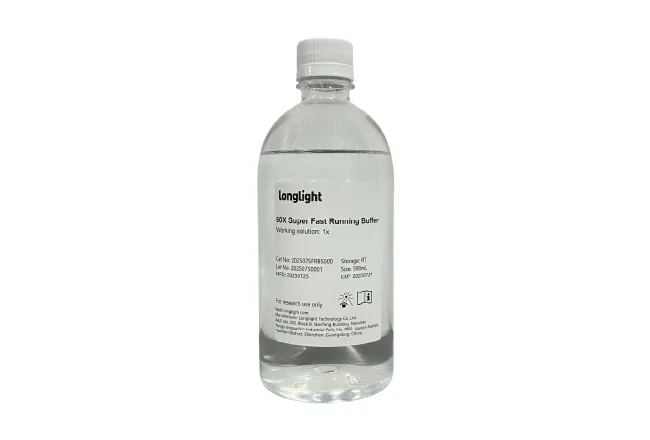
Our 50x Super Fast Running Buffer is a low-ionic-strength agarose buffer tuned for speed and clarity. In typical lab conditions, it compresses a 30-minute separation to 5 – 10 minutes – roughly 2.5 – 3× faster than standard 1x TAE or TBE. Because ionic load is lower, you can run at 25 – 30 V/cm while keeping bands tight and migration predictable. You don’t trade speed for smear; you gain both pace and readability.
We designed the buffer for real lab life, not a demo bench. It holds buffering strength across multiple reuses, which helps during busy runs and training sessions. It stays compatible with DNA gel extraction and ligation, so your post-gel steps remain unchanged. Stain as you prefer – add dye to the gel or stain afterward – your existing protocols still work.
✅ Field-Tested Benefits You’ll Notice In Week One
• Shorter cycle time: Clear bands in 5 – 10 minutes enable same-hour “go/no-go” calls.
• More samples per day: Faster runs lift throughput without buying new hardware.
• Seamless downstream use: No interference with gel extraction or ligation; proceed immediately.
• Stable performance: Strong buffering supports repeat runs and consistent results across batches.
Together, these gains protect momentum in cloning, PCR checks, CRISPR edits, and library validation – projects where quiet delays erode timelines and budgets.
From Setup To Impact: Tips, Use Cases, Next Steps
You don’t need to reinvent your SOP to benefit from Instant Agarose Gel Electrophoresis. Most teams are up and running in a single prep cycle.
✅ Quick Start Without The Guesswork
- Prepare once: Dilute the 50x concentrate 1:50 with distilled water to make a 1x working solution. Store at room temperature; both the concentrate and the 1x buffer are stable for at least 12 months.
- Keep it consistent: Use the same 1x batch for casting and running to keep migration uniform. Avoid diluting below 1x – under-strength buffer can distort mobility.
- Set voltage smartly: Start around 25 – 30 V/cm of gel length. Fine-tune to your cell design and buffer temperature. Expect 2.5 – 3× faster separations compared with 1x TAE/TBE.
- Stain as usual: Add DNA dye during gel prep or stain post-run. No need to rework your staining steps.
Temperature tip: Warm rooms or back-to-back runs can raise buffer temperature. If you see heat buildup, pause briefly, replace the buffer, or reduce voltage to protect band sharpness.
✅ Where Instant Agarose Gel Electrophoresis Pays Off Most
- In programs where a fast readout unlocks the next step the same day, the impact is immediate:
- Transcriptomics & Gene Regulation: Rapid QC of cDNA libraries and PCR fragments keeps schedules intact.
- Whole-Genome & Resequencing: Quick checks of library quality and adapters sustain sequencer utilization.
- Gene Editing & Synthetic Biology: Confirm edits and assemblies quickly to accelerate build-test-learn cycles.
- Drug Target Validation & Screening: Tighten QC loops in higher-throughput assays to reduce idle time.
- Cell Proliferation & Apoptosis: Faster fragment checks keep multi-day experiments synchronized.
✅ Implementation Playbook For Busy Labs
Start small, then scale with confidence:
- Pilot a lane: Run one gel side-by-side with your current buffer to benchmark speed and band quality.
- Tune voltage by gel length: Short gels tolerate the upper end of 25 – 30 V/cm; adjust for temperature and cell geometry.
- Standardize the batch: Adopt a single 1x batch per day or shift for casting and running to simplify QC.
- Schedule reuse sensibly: The buffer’s strong capacity supports multiple reuses; set a replacement cadence that fits your throughput and temperature profile.
- Document and roll out: Capture conditions that produce crisp bands on your samples, then codify them into the team SOP.
At Longlight Technology, our goal is simple: remove friction without adding complexity. With our 50x Super Fast Running Buffer, Instant Agarose Gel Electrophoresis becomes a reliable daily habit – 5 – 10 minute separations, 25 – 30 V/cm operation, and direct compatibility with your downstream steps. You’ll move faster, keep instruments working, and make decisions when they matter.
Closing Words
Ready to cut your gel time from half an hour to minutes? Contact Longlight Technology to request a trial pack or speak with an applications specialist. We’ll help you map voltage, gel percentage, and run conditions to your electrophoresis cell so you can see the benefit of Instant Agarose Gel Electrophoresis on day one.
